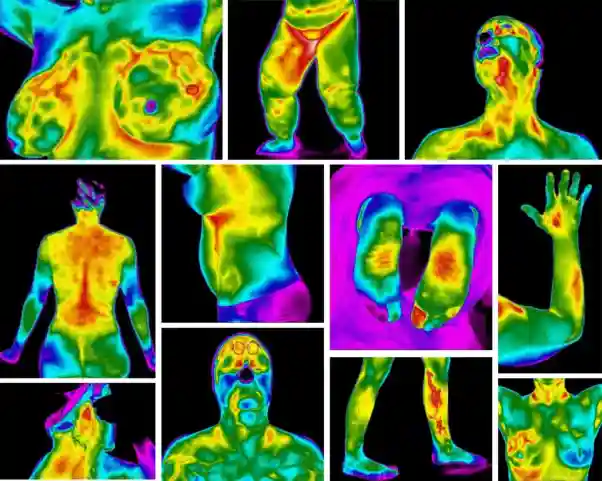
 Thermography is a non-invasive imaging technology that uses an infrared camera to measure heat patterns on the surface of your body.
These heat patterns may reflect areas of inflammation, blood flow, vascular activity, or other physiological changes.
Thermography is often called physiological imaging because it looks at how your body is functioning, rather than showing internal structures.
It doesn’t use radiation. It doesn’t touch your body. And it doesn’t involve compression, needles, or contrast dye.
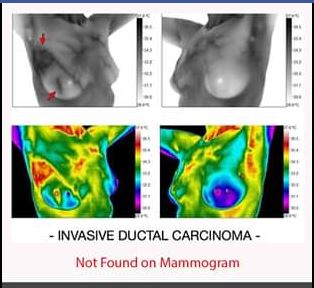 Thermography is different from structural imaging.
Structural imaging, such as mammography, ultrasound, MRI, X-ray, or CT scans, looks at what the tissues or structures look like inside your body.
Thermography, on the other hand, looks at temperature patterns on the surface of your body.
This means thermography can help show areas of activity, but it doesn’t show things like masses, cysts, tumors, fractures, or internal organs.
Both types of imaging provide different kinds of information, so they’re not interchangeable.
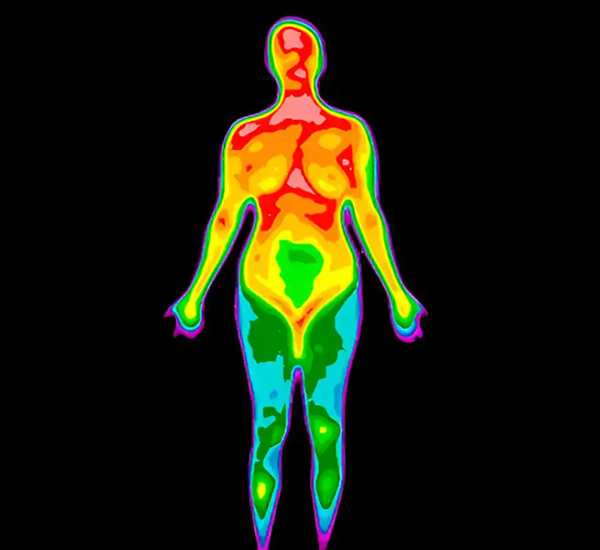 Thermography may help identify patterns related to:
But it’s important to note that these findings are informational, which means they don’t provide a diagnosis on their own.
Breast thermography looks at heat patterns in the breast, chest, underarm, and surrounding areas.
It may help show areas of increased thermal activity, asymmetry, or vascular change.
But breast thermography does not diagnose breast cancer.
It also does not replace mammography, ultrasound, MRI, biopsy, or evaluation by a qualified medical provider.
In any case, it’s best understood as an adjunctive tool. This means it may be used alongside appropriate medical screening or diagnostic testing, not instead of it.
Whole-body thermography looks at thermal patterns across multiple areas of your body.
This may include areas such as your head, neck, thyroid region, spine, joints, abdomen, breasts, and lymphatic regions.
The goal is to observe patterns of heat, inflammation, and physiological activity.
Whole-body thermography does not diagnose disease.
But it may help highlight areas that deserve closer attention, monitoring, or further discussion with a healthcare provider.
One thermography scan provides a snapshot.
Follow-up imaging allows thermal patterns to be compared over time.
And this is one of the main benefits of thermography.
A baseline can help show whether patterns stay stable, improve, or change, which makes thermography most useful as a monitoring tool, rather than a one-time test.
Among many other benefits, thermography is:
For people who want more information about how their body may be functioning, thermography can offer another layer of insight.
Thermography has clear limits, as it cannot:
What’s more, a normal thermography report doesn’t guarantee that no health issue is present, and an abnormal thermography report doesn’t mean cancer or disease is present.
Thermography results should always be understood as information about heat patterns, not as a diagnosis.
Thermography can be a helpful tool for observing heat patterns, inflammation, and physiological activity in the body.
Its value comes from being radiation-free, non-invasive, and useful for monitoring changes.
As such, it should be used as part of a broader health picture, alongside medical guidance, appropriate screening, and any recommended diagnostic evaluation.
Whether you’re exploring breast thermography, looking for a whole-body approach, or simply want a clearer understanding of your options, Patricia offers a thoughtful place to begin.
Find a clinic near you and take the next step with greater clarity and confidence.
Stay updated on thermography insights and preventative health tips.


Radiation-free, non-invasive thermography for women who want a more informed first step.
This website service, content, and products are for informational purposes only. Patricia Luccardi does not provide medical advice, diagnosis, or treatment.
© Copyright 2026 Patricia Bowden-Luccardi LLC All Rights Reserved | Privacy Policy
Website Developed by eVisionMedia.ca